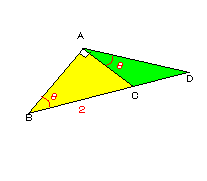
△ABCにおいて、BC=2、∠A=90°とする。
辺BCの延長上の点Cの側に、∠ABC=∠CADとなるように
点Dをとる。
ただし、∠ABC<45°とする。
(1)∠ABC=θとして、ACとADをθを用いて表せ。
(2)AD=\(\sqrt{\quad}\)3ACのとき、θの値を求めよ。
AC=BCsinθ=2sinθ ………(答)
∠ADC=180°-(θ+90°+θ)=90°-2θ
∠ACD=90°+θ
正弦定理より、
\(\frac{AD}{\sin (90^{\circ }+\theta )}=\frac{2\sin \theta }{\sin (90^{\circ }-2\theta )}\)
\(AD=\frac{2\sin \theta }{\cos 2\theta }\times \cos \theta =\frac{\sin 2\theta }{\cos 2\theta }=\tan 2\theta\) ………(答)
AD=\(\sqrt{\quad}\)3ACより、
\(\tan 2\theta =\sqrt{3}\cdot 2\sin \theta\)
\(\frac{2\tan \theta }{1-\tan ^{2}\theta }=2\sqrt{3}\sin \theta\)
\(\frac{1}{\cos \theta }=\sqrt{3}(1-\tan ^{2}\theta )\)
\(\cos \theta =\sqrt{3}(\cos ^{2}\theta -\sin ^{2}\theta )\)
\(\sqrt{3}(2\cos ^{2}\theta -1)=\cos \theta\)
2\(\sqrt{\quad}\)3cos2θ-cosθ-\(\sqrt{\quad}\)3=0
\((2\cos \theta -\sqrt{3})(\sqrt{3}\cos \theta +1)=0\)
∴ \(\cos \theta =\frac{\sqrt{3}}{2},-\frac{1}{\sqrt{3}}\)
0°<θ<45°より、cosθ>0
\(\cos \theta =\frac{\sqrt{3}}{2}\)
したがって、
θ=30° ………(答)